
Introduction
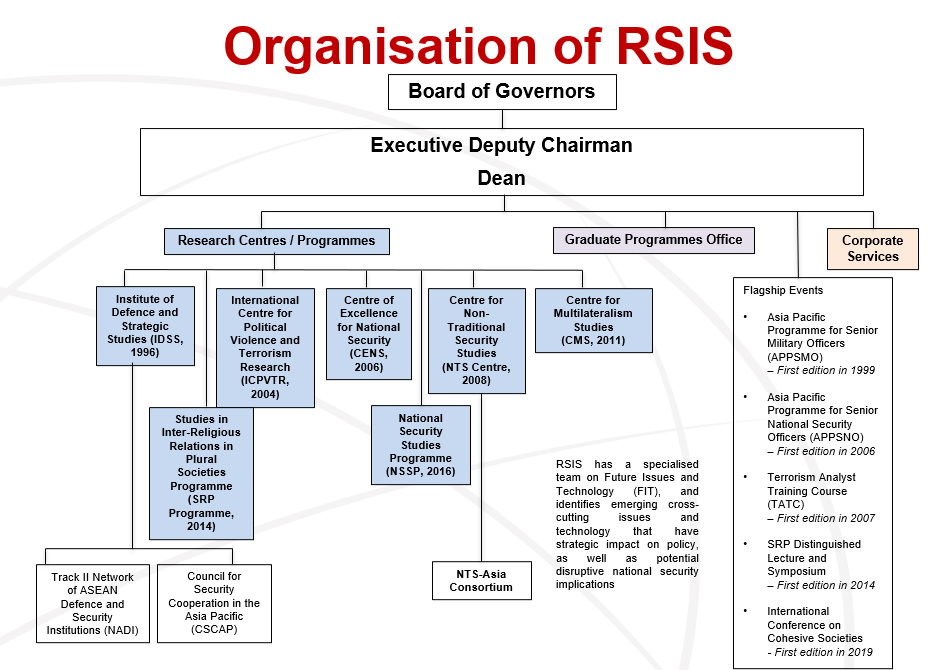
The S. Rajaratnam School of International Studies (RSIS) is a global think tank and school of graduate education offering Master of Science Programmes in Strategic Studies, International Relations, International Political Economy, and Asian Studies. Its five Research Centres and two Research Programmes, led by the Executive Deputy Chairman, and assisted by the Dean on the academic side, drive the School’s research, education and networking activities.
RSIS is consistently ranked among the top regional think tanks by international publications. Analyses and thought pieces by RSIS scholars and researchers are regularly featured in reputable publications, top-tier journals, and online platforms. Commissioned reports from RSIS are shared with policymakers and stakeholders, and in some cases, these have been used to launch further studies or specific projects with other partner organisations.
Since its inception, RSIS has expanded its research horizon to cover counter-terrorism and extremism, national security and defence issues, traditional and non-traditional security issues, interreligious studies, economic multilateralism, and regional economic integration. Increasingly, RSIS research delves into the emerging cross-cutting issues and technological developments having strategic impact and potential disruptive national and international security implications.
RSIS provides a rigorous professional graduate education in international affairs with a strong practical emphasis; conducts policy-relevant research in defence, national security, international relations strategic studies and diplomacy; and fosters a global network of like-minded professional schools.
RSIS researchers participate in deliberations at significant global and regional discussions on strategic and international affairs, such as the Shangri-La Dialogues, Council of Councils meetings, Trilateral Commission Conferences, and Halifax International Security Forums.
Governance
RSIS is an autonomous school within NTU Singapore. It has a Board of Governors comprising distinguished local and foreign representatives from the Government, business and academic communities, and practitioners in diplomacy and national security affairs. The Executive Deputy Chairman of RSIS is presently also the Director of Institute of Defence and Strategic Studies (IDSS).
Within the Office of the Executive Deputy Chairman, the Policy Studies group identifies new emerging trends of concern in the broad national security domain that may then be gradually incubated to form new policy-relevant RSIS research programmes.
The Future Issues and Technology (FIT) was launched on 1 September 2017. It identifies emerging cross-cutting issues and technology that have strategic impact on policy, as well as potential disruption national security implications.
Research Centres and Programmes
Research in RSIS covers these main areas:
- The Institute of Defence and Strategic Studies (IDSS) comprises nine research programmes, namely: China, Indonesia, Malaysia, Maritime Security, Military Studies, Military Transformations, Regional Security Architecture, South Asia, and the United States. The Military Studies Programme focuses on professional military education for the Singapore Armed Forces.
- The International Centre for Political Violence and Terrorism Research (ICPVTR) focuses on politically motivated violence and terrorism.
- The Centre of Excellence for National Security (CENS) covers cyber and homeland defence, radicalisation studies and social resilience.
- The Centre for Non-Traditional Security Studies (NTS Centre) researches into climate change, resilience and sustainable development; energy security; food security; health security; peace, human security and development; and water security.
- The Centre for Multilateralism Studies (CMS) focuses on capacity-building; diplomatic and security multilateralism; economic multilateralism; and international political economy.
- The Studies in Inter-Religious Relations in Plural Societies (SRP) Programme focuses on religious peace-building in plural societies; new developments in inter-religious relations from different religious perspectives; tolerance and co-existence in the historical religious traditions; and Singapore’s model of managing social cohesion.
- The National Security Studies Programme (NSSP) conducts research into key episodes of Singapore’s national security history and security challenges facing small, globalised, multi-ethnic city-states.
- The Futures Issues and Technology (FIT) focuses on emerging issues where science and technology intersect with national security.
Pioneering research in the non-traditional security studies domain has progressed to develop a dynamic country-level food systems model that linked scientific insights on climate change and demographic changes to the risks of production and export disruption in Asia, further research has ensued to identify approaches to mitigating such risks. Critical analyses on the status, challenges and potential solutions for promoting the adoption of the Internet-of-Things (IoT) and digital technologies in the food and agriculture sector in Southeast Asia and India, contribute towards developing greater resilience in Singapore and the broader regional food system.
RSIS produces both academic and policy-relevant research on security and international affairs. The School publishes scholarly research in top-tier academic journals and leading university presses, and distribute policy research in a timely manner to a wide range of readers. Relevant RSIS research contributes to rule-making and norm-setting in cyber domain and digitalisation. A strategic research area is the technological competition between China and the United States of America in the context of their geopolitical and security contestation, and implications for foreign interference in domestic politics and policy-making.
International Collaboration
Collaboration with other professional schools of international affairs to form a global network of excellence is a RSIS priority. RSIS maintains links with other like-minded schools so as to enrich its research and teaching activities as well as learn from the best practices of successful schools. RSIS is a member of the Council of Councils, an international initiative to connect leading foreign policy institutes from around the world in a dialogue on issues of global governance and multilateral cooperation. Membership of the Council of Councils includes leading institutions from twenty-four countries, roughly tracking the composition of the Group of Twenty (G20). The network facilitates candid, not-for-attribution dialogue and consensus-building among influential opinion leaders from established and emerging nations. RSIS’ contributions as member can be viewed here and its contribution to the Report on the Challenges of Global Governance Amid the COVID-19 Pandemic is here.
RSIS continues to serve key roles in security within the region, acting as Secretariat for both the Singapore National Committee of the Council for Security Cooperation in the Asia Pacific (CSCAP Singapore) and the Track II Network of ASEAN Defence and Security Institutions (NADI). These roles allow RSIS to actively contribute to discussions on regional security, support the ASEAN Regional Forum (ARF) and the ASEAN Defence Ministers’ Meeting (ADMM) with relevant inputs and timely ahead-of-the-curve policy recommendations, and build the confidence of think tanks and research institutions in the region.
RSIS also acts as the Secretariat of the Consortium of Non-Traditional Security (NTS) Studies in Asia. A network of 31 institutions and think tanks across Asia, NTS-Asia is a platform for academic and policy exchange on developments on NTS issues and research across the Asian region. The Centre for Non‐Traditional Security Studies staffs the secretariat. In 2018, it held its annual conference on “Resilience in the Face of Disruptions”, bringing together 50 participants from member institutions of the consortium to deliberate on disruptive implications relating to NTS issues in the region.
Graduate Education
RSIS offers a challenging graduate education in international affairs, taught by an international faculty of leading thinkers and practitioners. The Master of Science degree programmes in Strategic Studies, International Relations, International Political Economy, and Asian Studies are distinguished by their focus on the Asia Pacific, the professional practice of international affairs, and the cultivation of academic depth. Thus far, students from 66 countries have successfully completed one of these programmes. In 2010, a Double Master’s Programme with Warwick University was also launched, with students required to spend the first year at Warwick and the second year at RSIS. A select Doctor of Philosophy programme caters to advanced students who are supervised by senior faculty members with matching interests.
Endowed Professorships
RSIS has four endowed professorships that bring distinguished scholars and practitioners to teach and to conduct research at the School.
Last updated on 06/06/2024